Freezing whole beans is good practice, and the old advice had it backwards
The kitchen rule was always “never freeze coffee.” A 2016 study from the University of Bath, published in Scientific Reports, found that colder beans break into more uniform particles — and uniform particles extract more evenly.
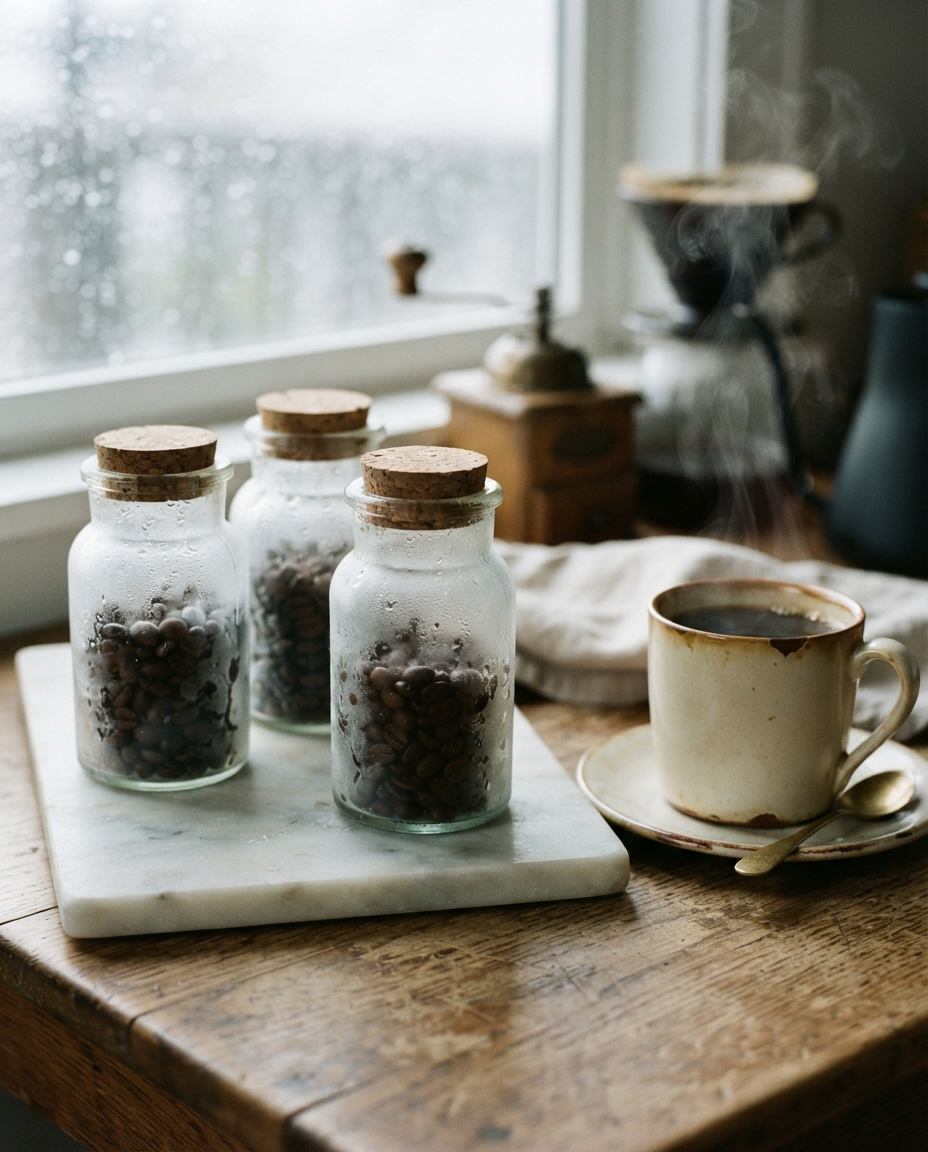
The advice I was given, repeatedly, across about four decades, was that the freezer ruins coffee. It was said with confidence and it was never explained, which in my old line of work was usually a sign worth following up.
The claim
Never put coffee in the freezer. Cold damages the beans, moisture gets in, and the coffee comes out flat.
What the research found
A team at the University of Bath examined how temperature affects the way a coffee bean fractures when it is ground. Their results were published in Scientific Reports in 2016. Colder beans, they found, break into a narrower distribution of particle sizes — fewer oversized chunks, fewer fines, more grounds close to the target size.
That matters because extraction depends on particle size. In a batch containing both powder and gravel, the powder over-extracts and turns bitter while the gravel under-extracts and stays sour, and both are in the same cup. Narrowing the spread narrows that conflict. The Bath team described the effect as large enough to be worth exploiting, and the finding is why grinding from frozen has become ordinary practice in competition coffee since.
Verdict: the blanket rule does not hold. Freezing whole beans, sealed and portioned, is a good way to keep them, and grinding them cold may improve the grind itself.
What the old advice was right about
Not everything in the folklore was wrong, and the part that survives is the part that matters most in practice.
What ruins frozen coffee is the in-and-out. Every time a bag comes out of the freezer, the beans sit below the dew point of the room, and water condenses onto their surface. Put the bag back in, and that moisture freezes onto the beans. Repeat this daily for three weeks and you have done real damage — moisture is one of the four things that stale coffee, and you have introduced it deliberately, every morning.
So the rule is not about cold. It is about cycling.
How to do it
- Whole beans only. Ground coffee has far too much exposed surface for this to help.
- Portion first. Divide the bag into small containers holding roughly a week each, so that you open one at a time.
- Seal properly. Airtight, and as little headspace as you can manage. Jars work; so does a freezer bag with the air pressed out inside a rigid container.
- Grind straight from cold. Do not thaw. Thawing is the condensation step, and it is the one you are trying to avoid.
- Do not refreeze. Once a portion is opened and has come to room temperature, keep it in the cupboard and finish it.
Who this is actually for
If you buy twelve ounces at a time and drink it within three weeks, the freezer solves a problem you do not have. Keep the bag sealed in a cool cupboard and get on with your morning.
It earns its place when the quantity and the timeline do not match: a two-pound bag, a coffee you loved and bought three of, a single-person household working through a pound slowly. Those are the cases where beans reliably go flat before they are finished, and where portioning into the freezer genuinely preserves something.
I have four small jars in the door of mine at the moment, which I would have found ridiculous in 2010.