The date printed on most coffee bags is the wrong date
“Best by” records the day a company stopped being willing to vouch for a bag. The number that decides how the coffee tastes is the roast date, and the bags that leave it off are usually leaving it off for a reason.
Nearly every bag of coffee in an American supermarket carries a date, and nearly every one of those dates is the less useful of the two a roaster could print.
A “best by” date is a shelf-life marker, set by the company, often a year or more out. It answers the question of whether coffee is safe and saleable, and the answer for roasted coffee is nearly always yes: dry, roasted beans do not spoil in any dangerous sense. What they do is go flat, and the best-by date says nothing whatsoever about that.
What the roast date tells you
Roasting drives carbon dioxide into the bean. Over the following weeks that gas works its way out, carrying aromatic compounds with it, while oxygen works its way in. The result is a curve, not a cliff, and it is a curve you can taste.
- Days 1 to 3. Still degassing hard. Coffee this fresh can brew unevenly and taste oddly sharp — the gas physically pushes water away from the grounds.
- Days 3 to 14. The window most brewing methods are happiest in.
- Up to a month. Still very good. Most people would not identify a difference.
- Around two months. Noticeably flatter. The aroma goes first, then the finish. Perfectly drinkable.
- Six months and beyond. Brown water with opinions.
Reading a bag in the store
Roasters who are proud of their turnover print the roast date, usually stamped or handwritten, often near the seal or on the back panel. It is a signal in itself. A bag that shows only “best by” is frequently doing so because the roast date is far enough back that nobody wanted it on the front of the package.
If only a best-by date is given, some roasters set it twelve months from roasting, which means you can work backwards to an estimate. Treat that as a guess, not a fact — the interval is not standardized, and some companies use six months, some eighteen.
The practical change
Buy smaller bags more often. Two weeks’ worth at a time, which for most households is twelve ounces rather than the two-pound bag that looks like better value on the shelf.
The two-pound bag is better value only if you finish it while it still tastes like something. Run the arithmetic on your own house: a couple drinking two mugs each morning gets through roughly a pound in three weeks. A single person takes twice as long, and the last third of that bag is a different and sadder coffee than the first third was.
About the oily ones
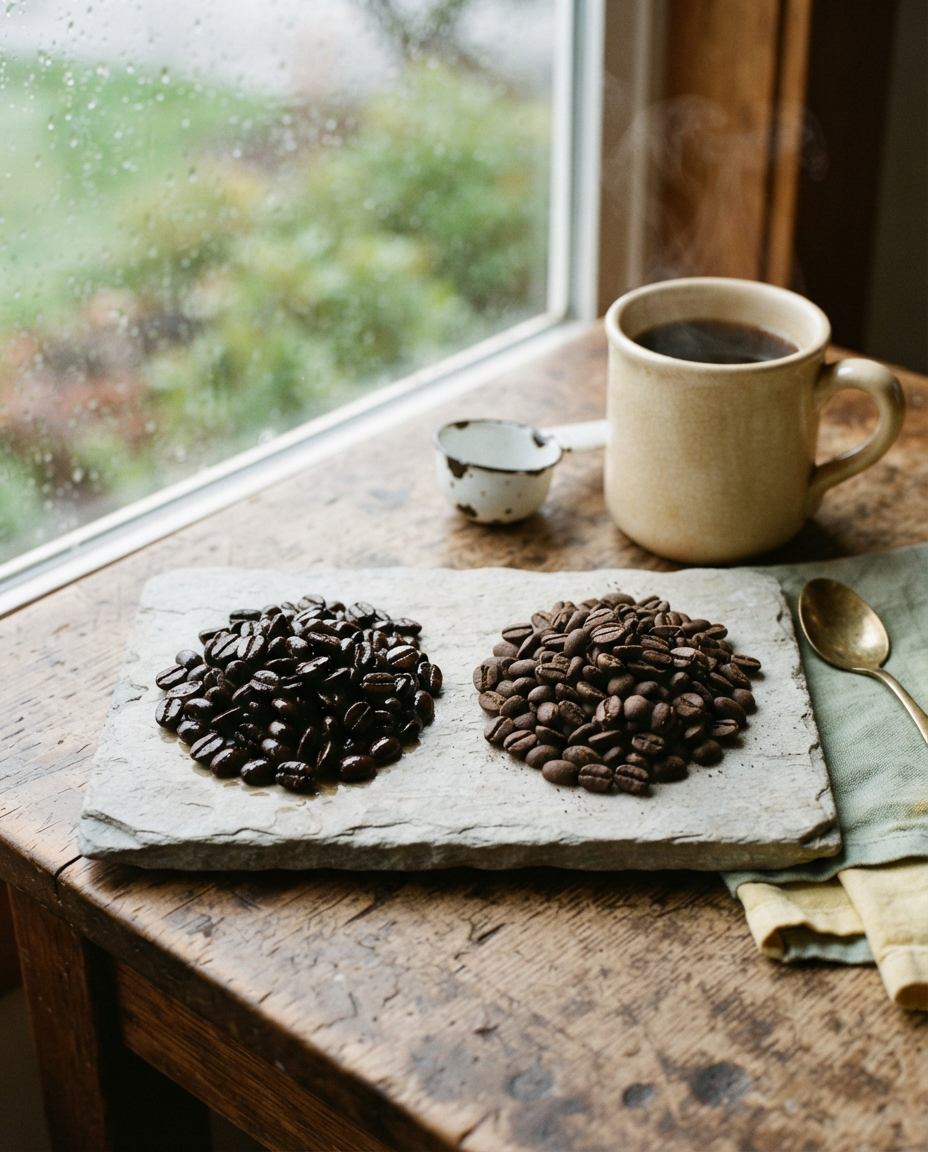
Visible oil on the surface of a bean is a function of roast level, not freshness — dark roasts push oils out during roasting, and a glossy dark-roast bean can be four days old. But those surface oils are exposed directly to air, so dark roasts do stale faster once they are out of the bag, and they are the beans most worth buying in small quantities.
I keep a pen in the kitchen drawer and circle the roast date the moment a bag comes home, which my family finds funny and which has never once cost me anything.