The thirty-second step most home brewers skip
Fresh coffee holds carbon dioxide. When hot water arrives, the gas pushes back and keeps the water from soaking the bed evenly, which produces a cup that is somehow both weak and sour at once.
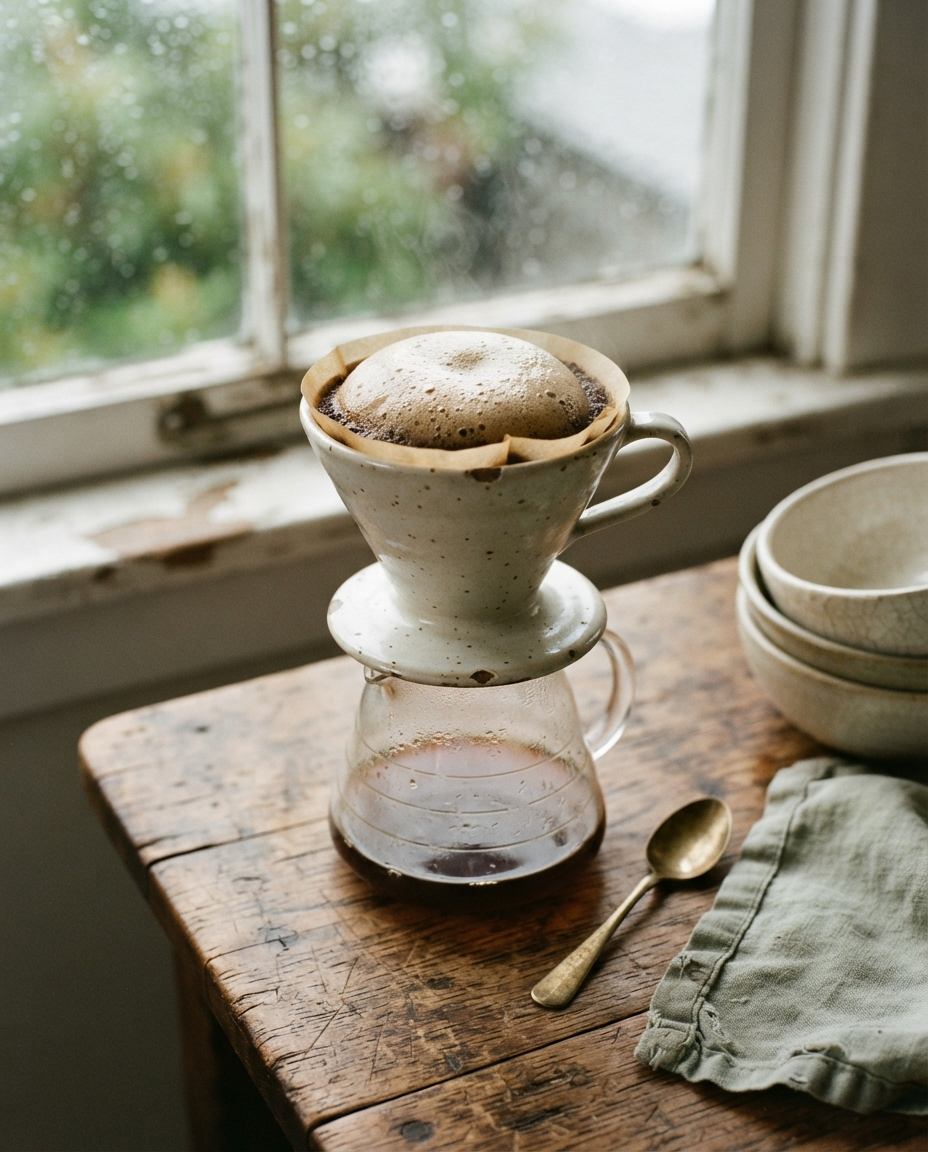
Roasting forces carbon dioxide into a coffee bean, and the bean holds onto a good deal of it for weeks afterward. Grind that bean and you open the structure; add hot water and the gas comes out all at once.
While it is coming out, it is in the way. Gas moving upward through a bed of grounds physically holds water off the surfaces it is meant to be dissolving. Water follows the paths of least resistance instead, running through channels and leaving whole sections of the bed barely touched.
The result is a cup that is confusing to taste: thin and underpowered, because most of the coffee was never properly extracted, and sour at the same time, for exactly the same reason.
The step
- Pour just enough water to wet all the grounds — roughly twice the weight of the coffee. For 30 grams of coffee, about 60 grams of water, which is a small splash rather than a pour.
- Watch it swell. The bed rises into a dome and covers itself in fine bubbles. That is the gas leaving.
- Wait thirty seconds. Up to forty-five for very fresh coffee, which will keep foaming.
- Then pour the rest, slowly, in circles, keeping the bed wet but not flooded.
It works in a pour-over and it works in a French press — pour a little, stir once gently, wait, then add the remaining water and put the lid on. It cannot be done in most drip machines, which control their own pour, though a few models have a pre-infusion setting that does precisely this.
The bloom as a test
Here is the part I find genuinely useful, beyond the cup itself: the size of the bloom tells you how old your coffee is.
- A tall, vigorous dome that keeps rising means recently roasted coffee, within two or three weeks.
- A modest rise with some bubbling is ordinary, and perfectly good.
- Almost nothing — the bed just gets wet and sits there — means the gas left a long time ago. Nothing is wrong with your technique. The coffee is old.
That last case is worth paying attention to, because it is information you cannot get any other way without a date on the bag. A flat bloom means you are brewing something that has been sitting on a shelf for months, and no adjustment to grind, ratio or temperature will retrieve what has already escaped.
How much it is worth
Less than the ratio, less than the grind, less than buying a fresher bag. It is a refinement rather than a rescue, and anyone who tells you it transforms a cup is overselling it.
But it is free, it takes half a minute, it makes the brew more consistent morning to morning, and it doubles as a freshness gauge. On those terms it is one of the better bargains in the kitchen.
My grandchildren find the timer ridiculous. The nine-year-old now asks to pour the water, so I consider the argument won.