Bitter, coarser. Sour, finer. The whole diagnostic in four words
Grind size is the dial most kitchens never touch, and it corrects more than a better bag of beans will. The rule underneath it is short: the longer the water sits with the coffee, the coarser the grind.
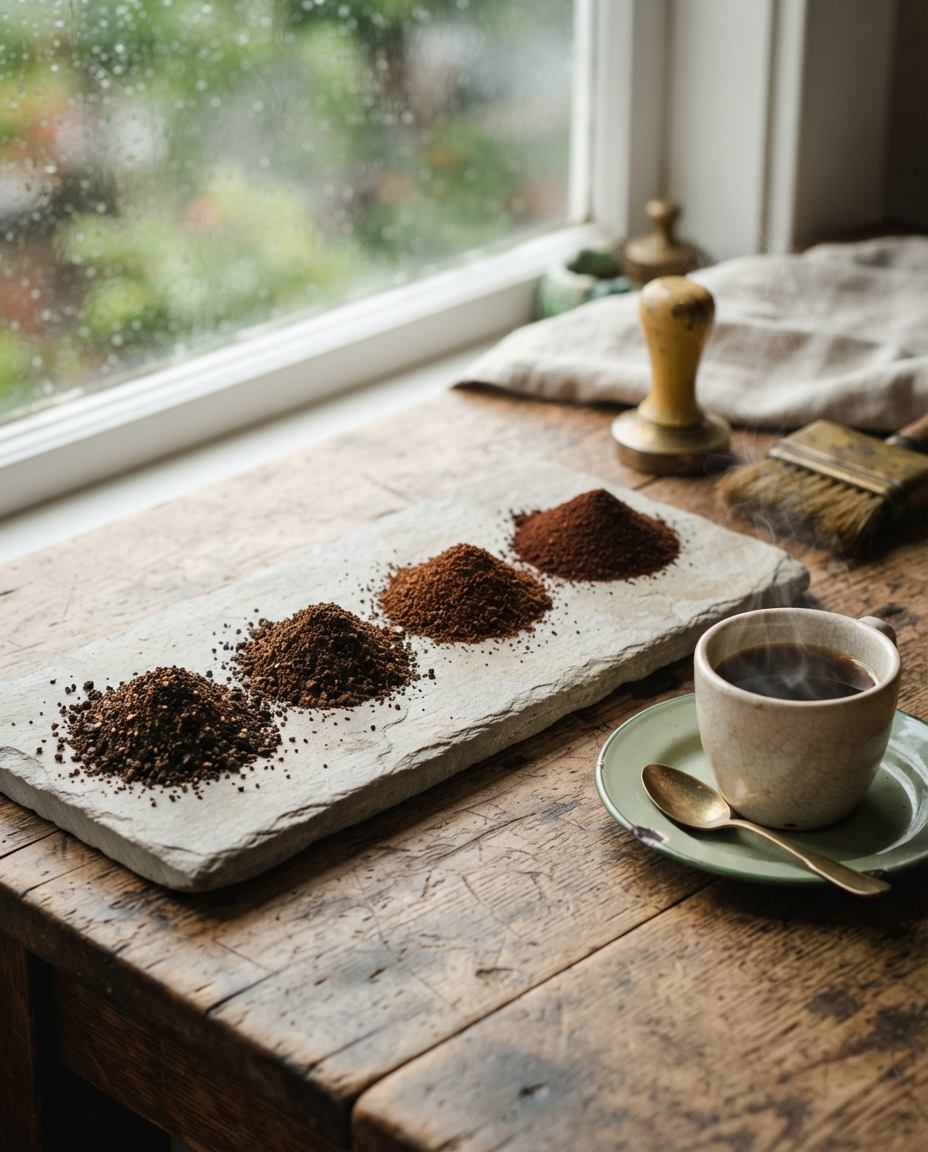
A lot of home coffee is bought on the assumption that the bag is the problem. Grind size gets far less attention, partly because a great many kitchens do not grind at all, and partly because the setting on the machine was chosen once, years ago, by somebody who no longer lives there.
It is the strongest dial in the kitchen after ratio, and unlike ratio, most people have never turned it deliberately.
Why it works
Grinding coffee is the act of creating surface area. Water dissolves flavor out of the ground particles, and it does so from the outside in. Small particles have a great deal of surface relative to their volume, so they give up their contents quickly. Large particles give them up slowly.
Every brewing method is a fixed amount of time that water spends touching coffee. A French press holds the two together for four minutes. An espresso machine pushes water through in about twenty-five seconds. The grind is how you make the coffee finish in the time that the method allows.
The longer the water sits with the coffee, the coarser the grind. That single sentence generates the entire table below.
The settings, by method
- French press — four minutes of full immersion, so coarse, like coarse sea salt.
- Drip machine — medium, about the texture of table salt.
- Pour-over — medium-fine, a little finer than drip, because a cone drains faster than a flat basket.
- Moka pot — fine, but not powder. Powder in a moka pot clogs and builds pressure, which is not a thing you want on a stove.
- Cold brew — twelve hours or more, so coarser than the French press, near the top of the range.
Reading the cup
You do not need to know the numbers on a grinder dial. You need to be able to taste two failures apart, and they are distinct once you know what you are looking for.
Bitter, harsh, drying across the back of the tongue? Over-extracted. The grind is too fine for the method. Go coarser.
Sour, thin, sharp at the front, as though the cup gave up halfway? Under-extracted. The grind is too coarse. Go finer.
Change one notch at a time and brew the same coffee, with the same ratio, at the same temperature. Two notches in a single jump and you will not know which one did it. This is tedious for exactly two mornings, after which it is settled for as long as you keep buying similar coffee.
Blade grinders
A blade grinder does not grind. It chops, and it chops at random, which produces powder and gravel in the same batch. The powder over-extracts while the gravel under-extracts, and the cup contains both failures at once — bitter and sour together, which is a confusing thing to taste and an impossible thing to correct by adjusting anything.
A burr grinder crushes beans between two fitted surfaces set a chosen distance apart, so the particles come out a consistent size. That consistency is the whole point, and it is why the cheapest burr grinder generally beats the most expensive blade one. I ground by hand for two years before my wrist filed a complaint.
Grind when you brew
Ground coffee has vastly more surface exposed to air than whole beans, and stale coffee is coffee that has been oxidizing. A bag of beans holds up for weeks. The same bag ground holds up for days.
If grinding at home is not practical — and for plenty of households it is not — buy smaller bags more often, ground to match your method, and keep them sealed and dark. That is a perfectly reasonable way to drink coffee. It is simply a faster clock.
Bitter, coarser. Sour, finer. Everything else on this page is explanation.